2026年10月10日 / Life in Japan
[Bank Account Opening Guide for Foreign Nationals] A Complete Explanation from How to Choose a Bank and Required Documents to Tips for “Overseas Remittance”!
Hello! This is Legal Gate Immigration Lawyer Office (VISA SUPPORT JAPAN), serving clients nationwide.
One of the most common questions we receive from foreign nationals living in Japan is: “I can’t open a Japanese bank account,” or “I want to send living expenses to my family overseas, but which bank is best?”
A bank account is essential for living and working in Japan—for receiving your salary, paying rent by direct debit, and so on—but Japanese banks have been tightening their screening of account openings for foreign nationals year by year as part of anti-money laundering measures.
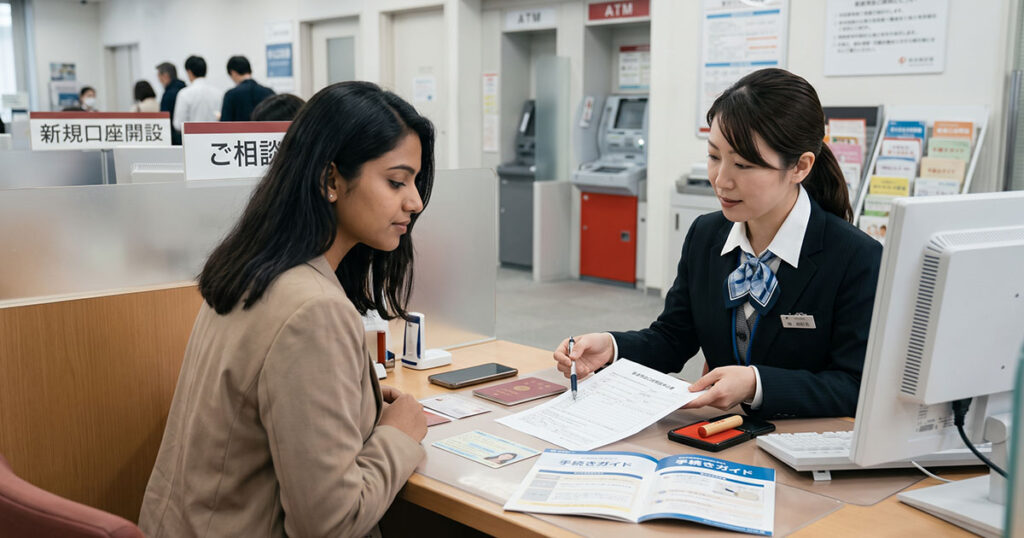
In this article, we will clearly explain the procedures and required documents for foreign nationals opening a bank account in Japan, recommended banks, and also how to send money overseas to your home country cheaply and smoothly!
1. The “Two Basic Requirements” for Foreign Nationals to Open a Bank Account in Japan
Not every foreign national can open an account immediately. In principle, you need to meet the following requirements.
① Having a period of stay of “6 months or more” (or being employed)
Under the rules of the Foreign Exchange Act (Foreign Exchange and Foreign Trade Act), those who have been in Japan for less than 6 months are in principle regarded as “non-residents” and cannot open a general deposit account (resident account). *However, if you have come to Japan on a work visa such as “Engineer/Specialist in Humanities/International Services” or “Specified Skilled Worker (Tokutei Ginou)” and are employed by a company in Japan, there are many cases where account opening is exceptionally permitted even if you have been in Japan for less than 6 months.
② Having “3 months or more” remaining until your period of stay expires
If little time remains on the validity of your residence card (generally less than 3 months), you may be refused an account opening.
2. “Basic Document List” Required for Opening an Account
Requirements vary somewhat by bank, but generally the following documents are required.
-
Residence card (required)
It must be within its validity period, and your latest address must be written on the back.
-
Passport
-
Copy of your certificate of residence (juminhyo) (issued within the last 3 months)
Obtained at your municipal office.
-
Personal seal (hanko) or signature
Online banks and Japan Post Bank increasingly allow accounts to be opened with a signature or via an app, but major city banks may still require a bank seal.
-
A Japanese phone number where you can be reached
-
Proof of employment or student status (if required)
Employee ID card, employment contract, etc. (You will be asked to present these if you open an account within 6 months of arriving in Japan.)
3. Easy for Foreign Nationals to Open! 3 Recommended Banks
If you feel the hurdles at the counter are high, or if the conditions are strict because you have just arrived in Japan, we recommend considering the following banks.
① Japan Post Bank (JAPAN POST BANK)
-
Features: With branches nationwide, this is the bank where account opening procedures are easiest, even for foreign nationals who have been in Japan for less than 6 months.
-
Key point: A multilingual “account opening application form creation app” and other services are available, making it relatively easy to use even if you are not confident in Japanese.
② Rakuten Bank
-
Features: An online bank where everything can be completed via a smartphone app without visiting a branch.
-
Key point: You can apply online if you have a residence card. No personal seal is required, making it popular with younger people and IT engineers.
③ Sumitomo Mitsui Banking Corporation (SMBC) / MUFG Bank (MUFG)
-
Features: These are major city banks, but they are putting effort into account opening procedures via smartphone apps.
-
Key point: They are often designated as the account for receiving salary from your company, and procedures tend to go smoothly if you have an employment contract or similar documents.
4. Sending Money Home! The Ease of “Overseas Remittance” and Recommended Methods
When sending the salary you earn in Japan to your family in your home country, rather than remitting directly from a Japanese bank, linking a Japanese bank account to a “dedicated remittance app/service (funds transfer service provider)” is currently the mainstream approach and by far the one we recommend.
Direct remittance from a bank (megabanks, Japan Post Bank, etc.)
-
Advantages: A sense of security.
-
Disadvantages: Very high fees (several thousand yen per transfer), unfavorable exchange rates, several days to about a week until the money arrives, and complicated counter or dedicated procedures.
Dedicated remittance services (Wise, Smiles, Kyodai Remittance, etc.)
-
Advantages: Overwhelmingly low fees, good exchange rates, money arriving within minutes to the same day via a smartphone app, and extensive multilingual support.
-
How to use: The system works by transferring money from your Japanese account, such as at “Japan Post Bank” or “Rakuten Bank,” to the remittance service’s account in Japan, and then sending it on to your home country.
[Strong for Overseas Remittance] Recommended Services and Banks
-
Wise: A remittance service used all over the world. Its fees are extremely low and it is highly transparent, so it is used by many foreign nationals.
-
Smiles: A remittance app that is very popular with nationals of the Philippines, Vietnam, and Nepal.
-
Sony Bank: If you want to make overseas remittances through a Japanese bank, Sony Bank is recommended. It has a multilingual app (English supported), and fees for foreign currency remittances are set relatively low.
[Extremely Important: Obligation to Submit Your My Number]
When sending money from Japan overseas, whether through a bank or a remittance app, Japanese law (the Act on Submission of Statements of Overseas Wire Transfers for Purpose of Securing Proper Domestic Taxation) **always requires submission of your “My Number (Individual Number)”**. Foreign nationals who plan to make overseas remittances need to obtain a My Number Card at their municipal office in advance, or obtain a certificate of residence that includes their My Number.
5. “Critical Points to Note” When Opening and Using a Bank Account as a Foreign National
Point 1: Always notify your bank when you renew your residence card
Once you renew your visa and receive a new residence card, be sure to file a “notification of renewal of period of stay” with the bank where you hold an account. If you fail to do so, your account may be temporarily frozen.
Point 2: Always complete “account closure procedures” when returning home (buying and selling accounts is a crime!)
When permanently returning to your home country, be sure to close your account. Selling or transferring an account you no longer use to another person is a serious crime punishable under Japanese law (illegal transfer, fraud, etc.). Sold accounts are misused for criminal purposes, and you risk never being able to re-enter Japan in the future.
Summary: For a Safe and Secure Start to Your Life in Japan
Opening a bank account and sending money overseas as a foreign national can proceed smoothly by preparing the appropriate documents and choosing services that match your status of residence (visa) and your purposes.
For employing companies as well, supporting foreign employees so that they can smoothly open a salary account and set up an environment for remitting money to their home country is directly linked to employees’ peace of mind and retention.
If you are a company that wants to “establish a system for accepting foreign employees” or “consult about everything from work visa applications to support for starting life in Japan,” or a foreign national with such needs, please feel free to contact Legal Gate Immigration Lawyer Office (VISA SUPPORT JAPAN), which provides services nationwide!